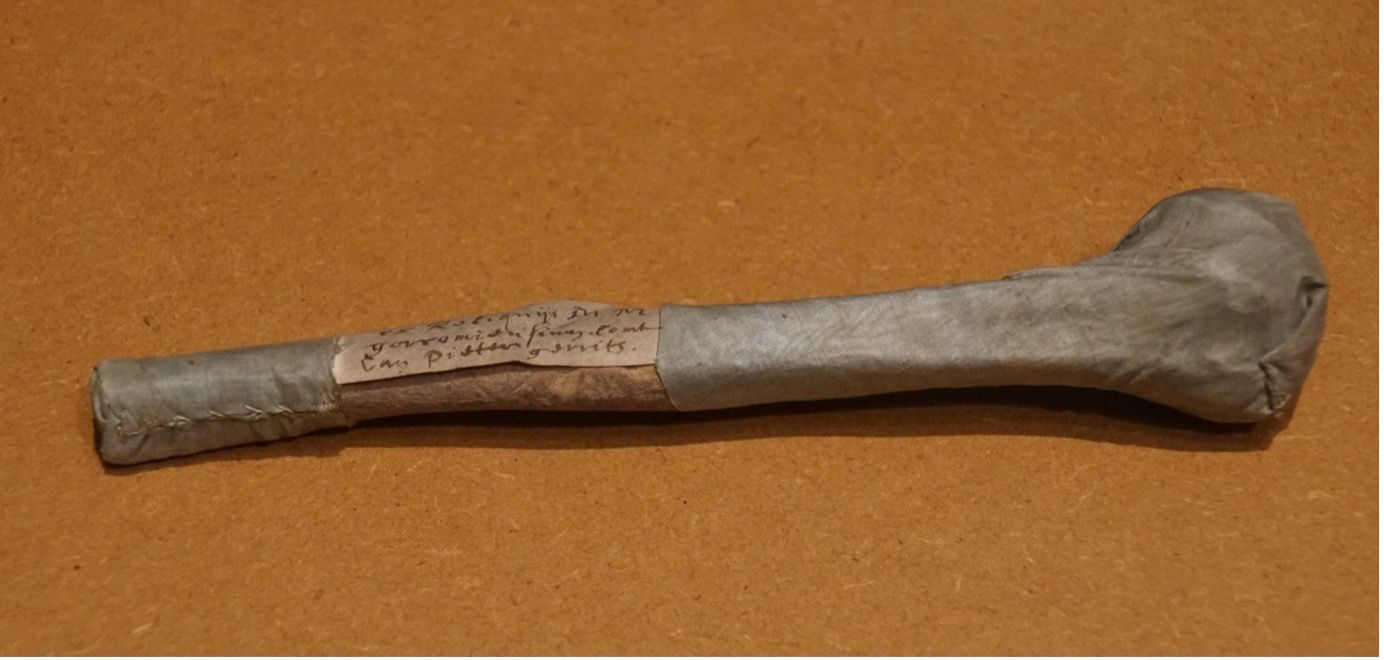
Jonas van Tol, assistant professor in Early Modern History at UvA, explores how physical remains of victims of the European wars of religion were recruited for the fight. Using bone relics as a point of departure, he demonstrates how religiously-motivated violence left imprints on the landscape and continued to play a key role in the contest to confessionalize space. In response to his lecture, Judith Pollmann, professor in Early Modern History at Leiden University, will act as a reviewer.
Event details from: ACSEM Object Colloquium: Bone
Date
13 December 2022
Time
15:30 – 17:00
On the quiet outskirts of the small town of Brielle stands the impressive structure of the Church of the Martyrs of Gorcum, housing the bones of nineteen Catholic martyrs who were executed on the same spot in 1572. It reminds us of the importance of place in the history of religious conflict. The confessional violence that erupted in the mid-sixteenth century was as much a battle for space as a battle about ideas. The material was as important as the spiritual. The competing confessions strove to capture or defend strongholds that could serve as little islands of purity and holiness in a sea of uncertainty. This lecture will argue that the dead played an active role in these religious battles for space. Catholic ideas about the relation between the immanent and the transcendent ensured that the victims of Protestant aggression could be employed to hold space by imbuing it with holiness. Once this had happened, it could not be undone. The inversion at the heart of the theology of martyrdom meant that the more aggression and destruction was visited on them, the more venerable the locations associated with the victims of violence. Moreover, the practice of fragmenting and translating relics meant that their remains could be marshalled for territorial expansion. In this lecture, the story of the Martyrs of Gorcum will be used to explore the important role of the dead in the religious battle for space.
Spoken language: English. Drinks on location (at the UB) afterwards.
Amsterdam Centre for Studies in Early Modernity (ACSEM)
ACSEM is formerly knows as Amsterdam Centre for the Study of the Golden Age. The new name comes with a new annual program - the Object Quolloquia Series. The series has the overarching theme: Exploring the World through the Material Turn. All speakers have taken up the challenge of creating a coherent, interdisciplinary program. Thanks to them, it promises to be a year of in-depth discussion and new acquaintances. The full annual program can be found below.
The Object Quolloquia Series
The Object Colloquia Series explores the world through the material turn. Each interdisciplinary duo of speakers takes one object or product as a point of departure to study and discuss various aspects of Early Modern art, culture, and history. These series are organized by the Amsterdam Centre for Studies in Early Modernity (ACSEM).